Septic Tank Pumping in Central Oklahoma by Local Experts
Fast, honest septic pumping for homeowners in Guthrie, Edmond, Piedmont, and the OKC metro.
We pump conventional and aerobic tanks, tell you what we found in plain English, and don’t sell you anything you don’t need. Same-day service is usually available if you call before noon.
✅ DEQ-Certified Pumper #760 | 💙 Family-Owned Since 2016 | ⭐ 4.9 Stars, 231 Google Reviews
Why Septic Pumping Is So Important for Your Home
Your septic tank is designed to separate the solids from the wastewater. Grease and lighter material float to the top, forming the scum layer. Heavier solids settle to the bottom as sludge. The liquid between those two layers, called effluent, flows out of the tank and into the drain field.
Over time, the scum and sludge layers build up and leave less room in the tank for wastewater. Pumping removes those solids before they build up enough to cause problems or make their way into the drain field.
Many serious septic problems we see start with delayed pumping maintenance. Pumping is one of the simplest ways to stay ahead of issues and keep your system working reliably.

How Often Should Septic Tanks Be Pumped in Oklahoma?
Most Oklahoma homes should pump a conventional septic tank every 3 to 5 years and an aerobic system’s trash tank every 1 to 3 years. How close you land to either end depends on your tank size, how many people live in the house, and what goes down the drains.
Conventional Septic Systems
Most homes with a 1,000 gallon tank should plan on pumping every 3 to 5 years. A family of five on a 1,000 gallon tank may be closer to 2 or 3. A retired couple on a 1,500 gallon tank can often go 7 or more.
Aerobic Septic Systems
Most aerobic systems have a small trash tank that collects solids before the treatment chamber and should be pumped every 1 to 3 years, and your required maintenance inspections are the easiest way to catch when it’s ready. If you have a 1000 gal tank before your aerobic system you can likely go longer between pumping.

Household size, water usage, tank size, and what goes down your drains all play a role. If you are unsure where you fall, we’re happy to help you determine a schedule that makes sense for your home and lifestyle.
*Use the 500 gal tank size for aerobic systems without a 1000 gal tank in front of it.
Signs That Your Septic Tank Is Full
Your septic tank does not have a gauge that tells you when it needs to be pumped. Most of the time, there is no obvious warning until something starts acting up. Knowing what to watch for can help you catch a problem before you end up with sewage in the house or a much more expensive repair.
Seeing one of these symptoms does not automatically mean something is failing. However, these signs are your system’s way of telling you it needs attention. Scheduling service sooner rather than later helps prevent small issues from turning into disruptive, costly problems.
Several drains are running slow.
One slow sink or shower may be a plumbing clog. If toilets, sinks and showers throughout the house are all draining slower than normal, the problem may be farther downstream, including the septic system.
Your toilets or drains are gurgling.
Gurgling usually means air is getting pushed back through the plumbing. It can happen when wastewater is having trouble moving through the system. If you are hearing it from more than one fixture, it is worth paying attention to.
You smell sewage in your yard
Septic odors around the tank or drain field are never something you should ignore.
The ground over your drain field is wet or unusually green.
A little greener grass over a drain field is not automatically a problem. But soggy ground, standing water or a noticeably bright green area when the rest of the yard is dry can be a sign that the drain field is receiving more wastewater than it can handle.
You have no idea when the tank was last pumped.
Sometimes you do not need a warning sign. If it has been several years since the tank was pumped, or you bought the house and have no idea when it was last done, having it pumped and inspected gives you a good starting point.
What to Expect During Your Septic Pumping Appointment
Most pump-outs take about an hour from the time we pull in to the time we pull out. Here’s how it goes.
Before we arrive
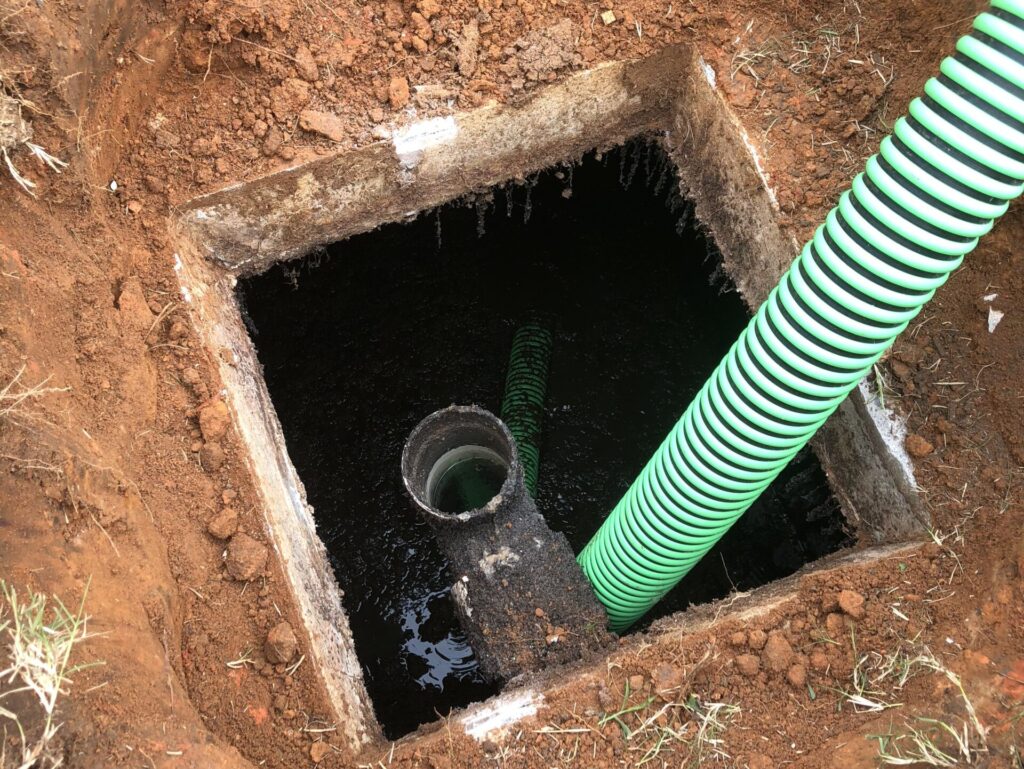
We’ll confirm the appointment and ask whether you know where your tank is. If you don’t, no problem. We can locate it, and if the lid is buried we can dig it up. You don’t need to be home, but if you’d like to walk through what we find, we’re glad to have you there.
Locating and opening the tank
We uncover the lid, note the depth, and open the tank. If you have risers, this takes about two minutes. If you don’t, this is usually the longest part of the visit, which is why so many customers add a riser while we’re there.
*There may be an additional charge for locating or digging up the tank.
Pumping the tank
We pump out everything: the scum layer on top, the liquid in the middle, and the sludge on the bottom. Pumping only the liquid and leaving the sludge is a shortcut some companies take, and it’s the reason a tank can “need pumping again” a year later. We don’t do that.
A quick look while it's open
With the tank empty we check the baffles, the inlet and outlet, and the general condition of the tank. This isn’t a full inspection, but it’s a free snapshot, and it’s how we catch small problems before they get worse.
Closing up and walking you through it
We put the lid back, backfill anything we dug, and clean up. Then we tell you what we saw in plain language: how full the tank was, whether anything looked off, and when you should plan the next pump-out. No pressure, no upsell. If something needs attention, we’ll explain your options and let you decide.
Thinking about a riser?
While the tank is open is the cheapest time to add one. A riser brings the lid to ground level, so future pump-outs and inspections skip the digging entirely. Ask us while we’re there and we’ll tell you whether it makes sense for your tank.
How Much Does Septic Pumping Cost in Oklahoma?
Septic pumping with Cyclone starts at $450 for a conventional system and $550 for an aerobic system. That price includes one hour on site to locate the tank, dig up the lid, and pump it. Most pump-outs finish inside that hour, so for most customers the starting price is the final price.
What's included
- Locating the tank and digging up the lid
- Pumping the full tank: scum, liquid, and sludge, not just the liquid off the top
- A visual check of the baffles, inlet, and outlet while the tank is open
- Backfill and cleanup
- Licensed hauling and disposal at a DEQ-approved facility
- A plain-English rundown of what we found and when to plan the next one
Why aerobic tanks cost more
Aerobic systems have more than one compartment. The trash tank, the aeration chamber, and the pump tank each hold solids, and each one gets pumped. More compartments, more time, more to haul.
What can push a visit past the hour
- A lid buried deep or nobody knows where the tank is
- A tank that hasn’t been pumped in 10 years and is packed with solids
- Multiple tanks or a very large tank
- Access problems, like a tank we can’t get the truck within 100 feet of
Time beyond the first hour is billed at $150 per hour.
The one upgrade that pays for itself
If your lid is buried, ask about a riser while the tank is open. It brings the lid to ground level, so every future pump-out and inspection skips the digging and stays well inside the hour.
Why we're not the cheapest number you'll find
You’ll see ads for pump-outs at a lower cost. Ask two questions before you book one: does that include locating and digging up the lid, and are they pumping the sludge or just the liquid?
A price that’s too good is usually missing something you’ll pay for later.
Why Homeowners Choose Cyclone for Septic Pumping
Homeowners choose Cyclone because:
- Family-owned and run out of Guthrie since 2016
- Three DEQ-certified installers and a certified pumper on staff
- We pump and repair conventional and aerobic systems, so we know what we’re looking at when the lid comes off
- Education, not pressure. We’ll tell you what we saw and what your options are, and then it’s your call
-
 Bryan
★★★★★
September 2026
Maintains our septic system. GREAT company. Did the full install on our new home. Never had one problem. Does a full inspection every 6 months, replaces sprayer heads when needed. Called several times about advice on maintenance - great … More help and very knowledgable. I am so glad our builder picked this company! UPDATE 9/3/2026 - Got to meet the owners Dawn and Michael today! What wonderful people and so responsive to their customers. They did a smoke test to see if there was any leakage due to recent issues and recommended an extension on two exhaust pipes on the roof. Their installed system was working perfectly after 5 years! I've also gotten Septlink installed by them last year. Highly recommend. It monitors the whole system and alerts me and them when there are any problems. No more guessing games whether something is wrong, and I sure want to know when a pump or aerator issue is happening BEFORE "other" EXPENSIVE problems happen (if you know what I mean). In all my years, this is the best company I have ever had the pleasure working with and the owners are exceptional people.
Bryan
★★★★★
September 2026
Maintains our septic system. GREAT company. Did the full install on our new home. Never had one problem. Does a full inspection every 6 months, replaces sprayer heads when needed. Called several times about advice on maintenance - great … More help and very knowledgable. I am so glad our builder picked this company! UPDATE 9/3/2026 - Got to meet the owners Dawn and Michael today! What wonderful people and so responsive to their customers. They did a smoke test to see if there was any leakage due to recent issues and recommended an extension on two exhaust pipes on the roof. Their installed system was working perfectly after 5 years! I've also gotten Septlink installed by them last year. Highly recommend. It monitors the whole system and alerts me and them when there are any problems. No more guessing games whether something is wrong, and I sure want to know when a pump or aerator issue is happening BEFORE "other" EXPENSIVE problems happen (if you know what I mean). In all my years, this is the best company I have ever had the pleasure working with and the owners are exceptional people. -
ASHLEY
★★★★★
August 2026
I reached out because we had an alarm going off. They were super friendly and quickly scheduled a time to come out, take a look, and repair the issue. Great service!
-
Jane
★★★★★
August 2026
They are always ready to come and fix what's broken! Alicia, Heather and their guy who repairs are all reliable and kind. Customer service is superb!
-
Renee
★★★★★
August 2026
-
Rebecca
★★★★★
August 2026
Cody was very helpful in quickly solving our minor issue while our units are under warranty. Thank you!


Septic Pumping Questions Homeowners Ask Most
How much does septic pumping cost in Oklahoma?
$450 for pumping a conventional tank up to 1000 gal.
$550 for pumping an aerobic tank up to 1500 gal
Pricing includes up to 1 hr of service.
How long does septic pumping take?
Service typically takes 1 hr or less
Do I need to be home for septic pumping?
No, if you have a credit card on file, you do not need to be home.
Just make sure the tank area is accessible. If you’re unsure where it’s located or think it may need to be uncovered, let us know so we can plan ahead.
Why does my system seem to need pumping more often than expected?
If pumping is needed more frequently, it usually means something else is going on, like higher water use or extra strain on the drain field. This is fairly common, and we can help you understand what’s happening and what options make sense.
Do you offer same-day or emergency septic pumping?
We do our best to accommodate same-day requests during business hours when availability allows. Calling earlier in the day helps.
Do septic tank additives mean I can skip pumping?
It is a common misconception that additives replace pumping. Pumping is the only way to remove inorganic solids from your tank.
Areas We Serve
Cyclone Septic & Plumbing proudly provides septic tank pumping for homes throughout the Oklahoma City metro, including Guthrie, Edmond, Piedmont, and surrounding Central Oklahoma communities. Our team understands local soil conditions, system types, and Oklahoma DEQ requirements, allowing us to deliver service that fits your area and your home.
Schedule Septic Pumping With Confidence
If it’s been a few years since your last pumping, or you’re noticing common signs like slow drains, gurgling toilets, or unpleasant odors, now’s the time to take care of it.
Use the form below to schedule service, or give us a call at (405) 373-1540 today.